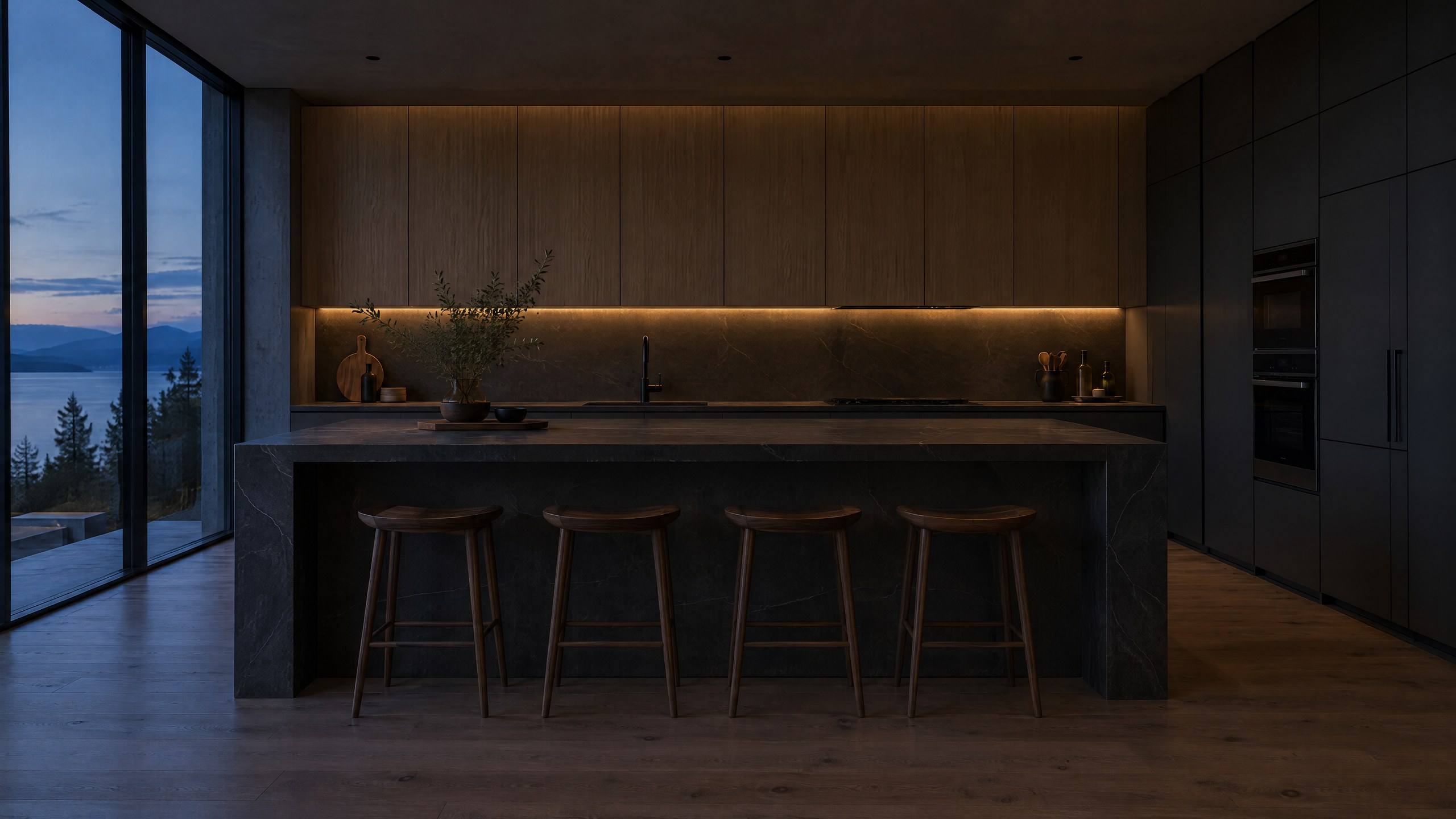
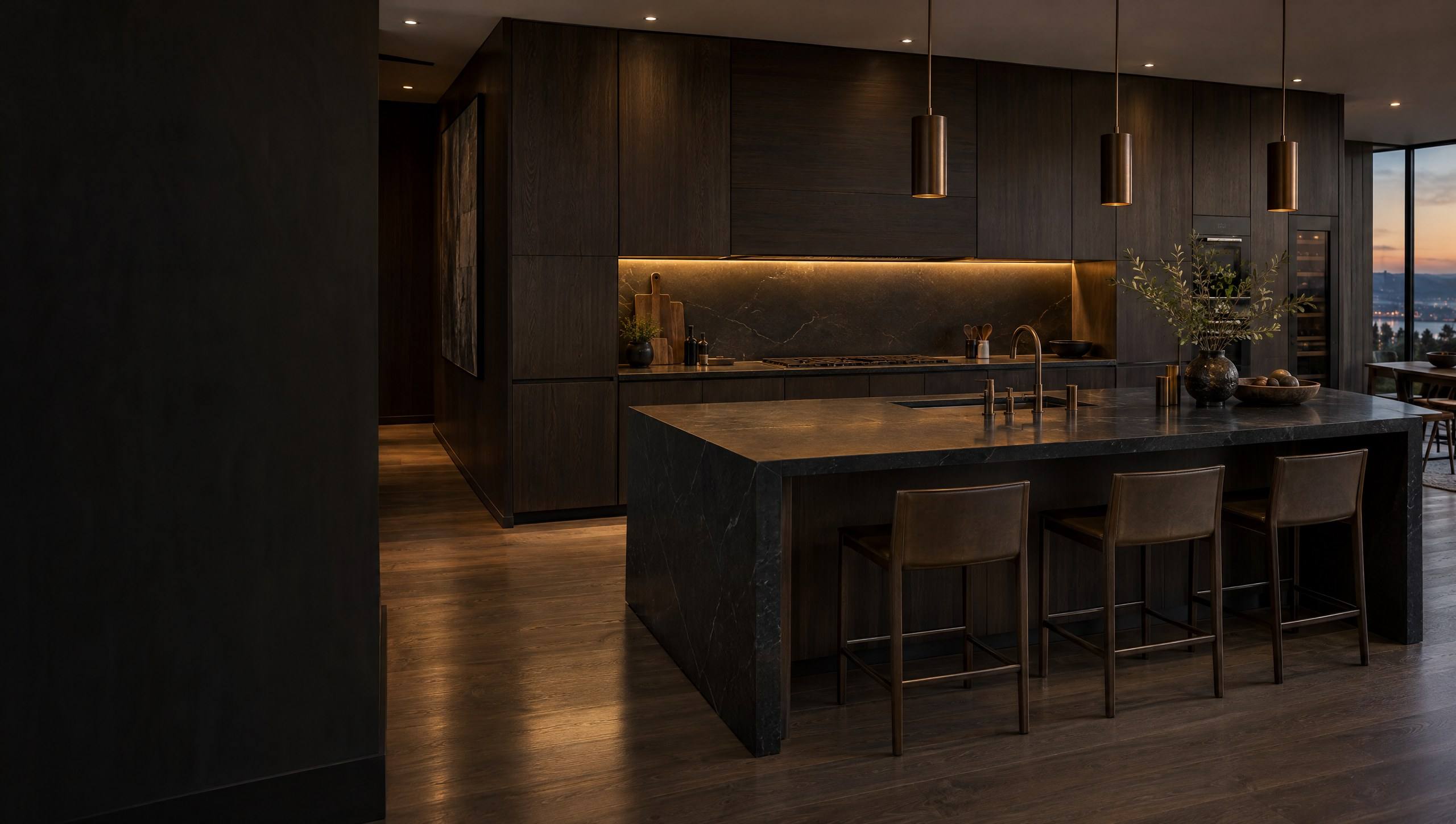
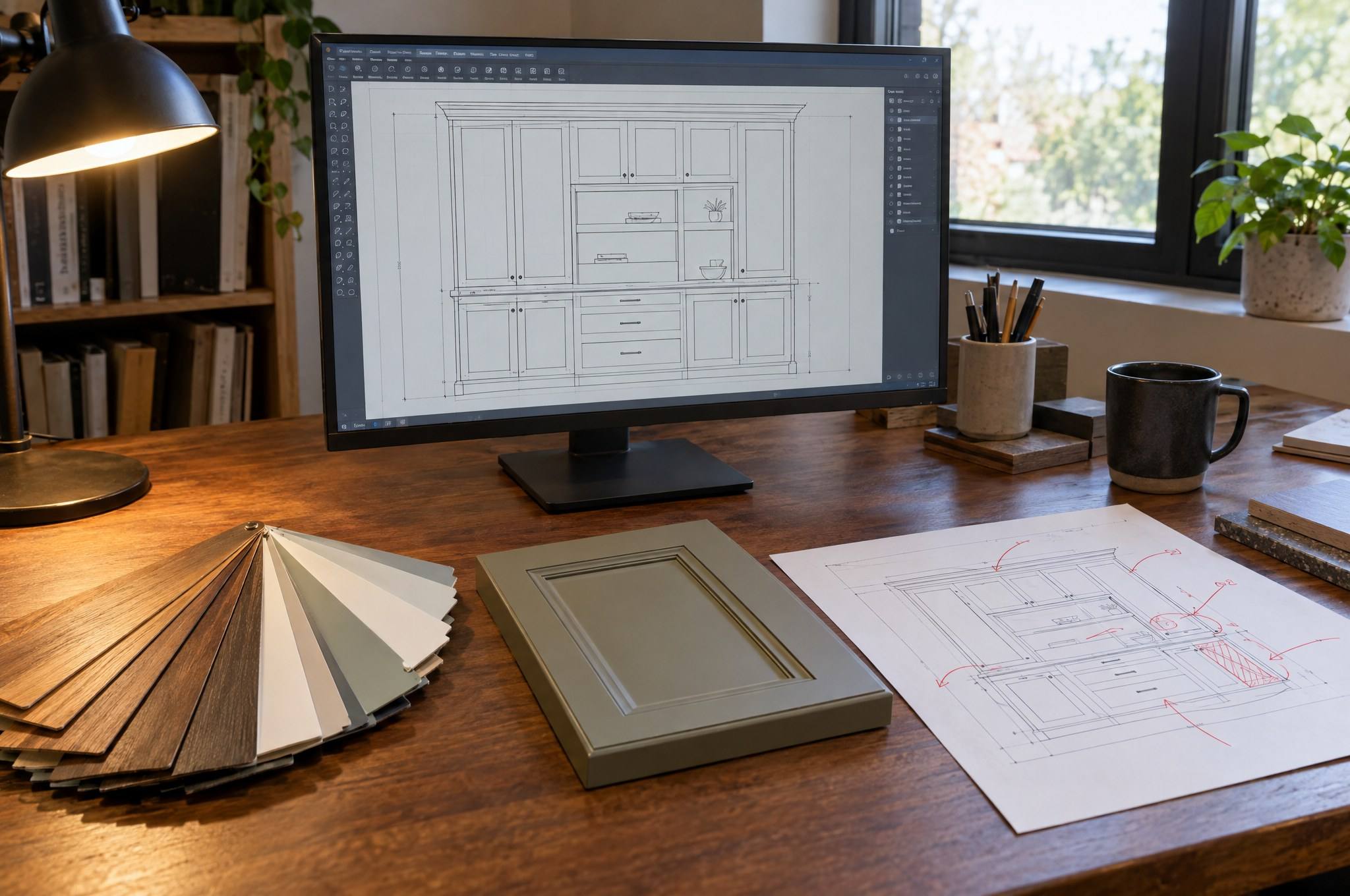
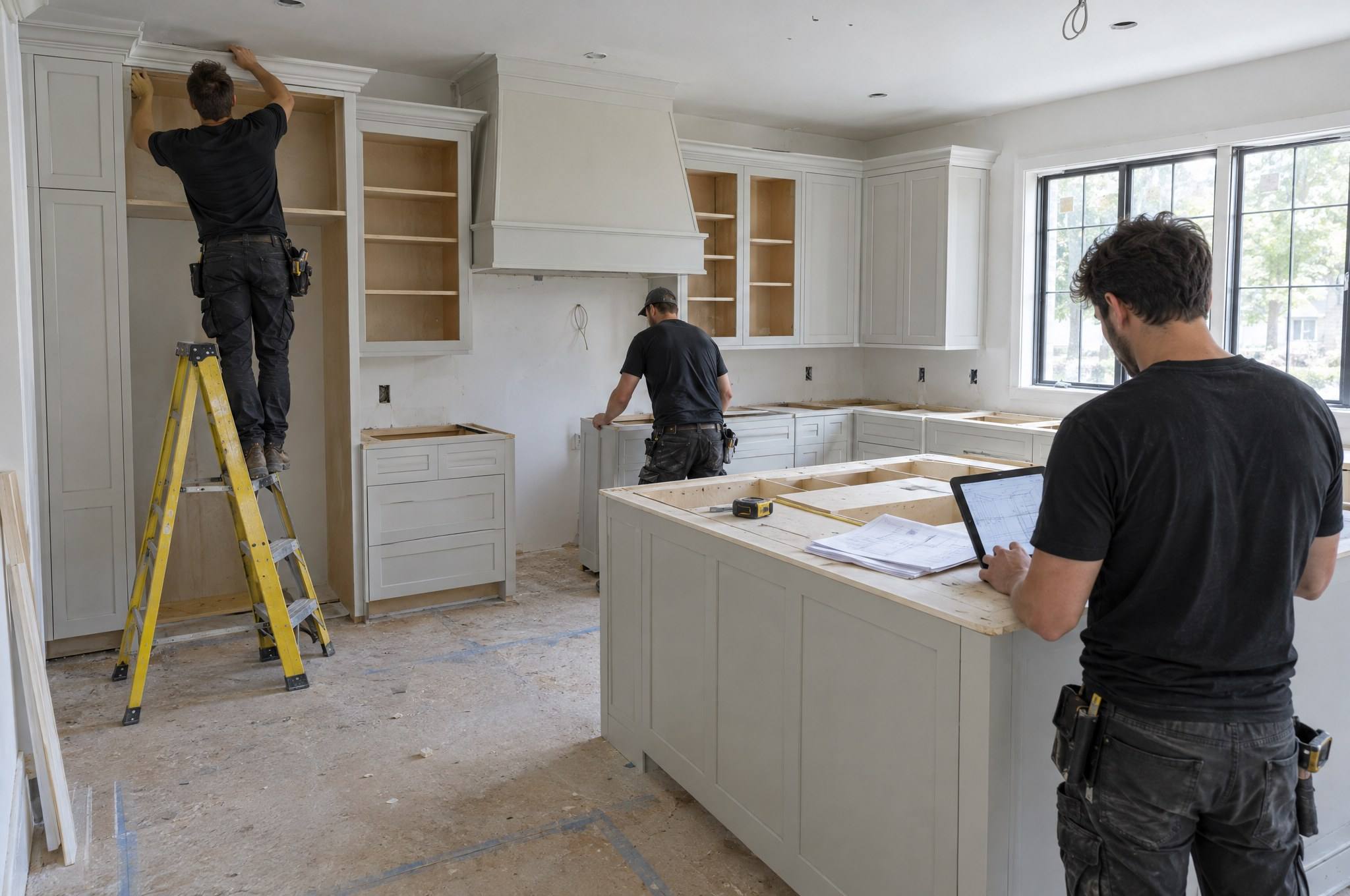
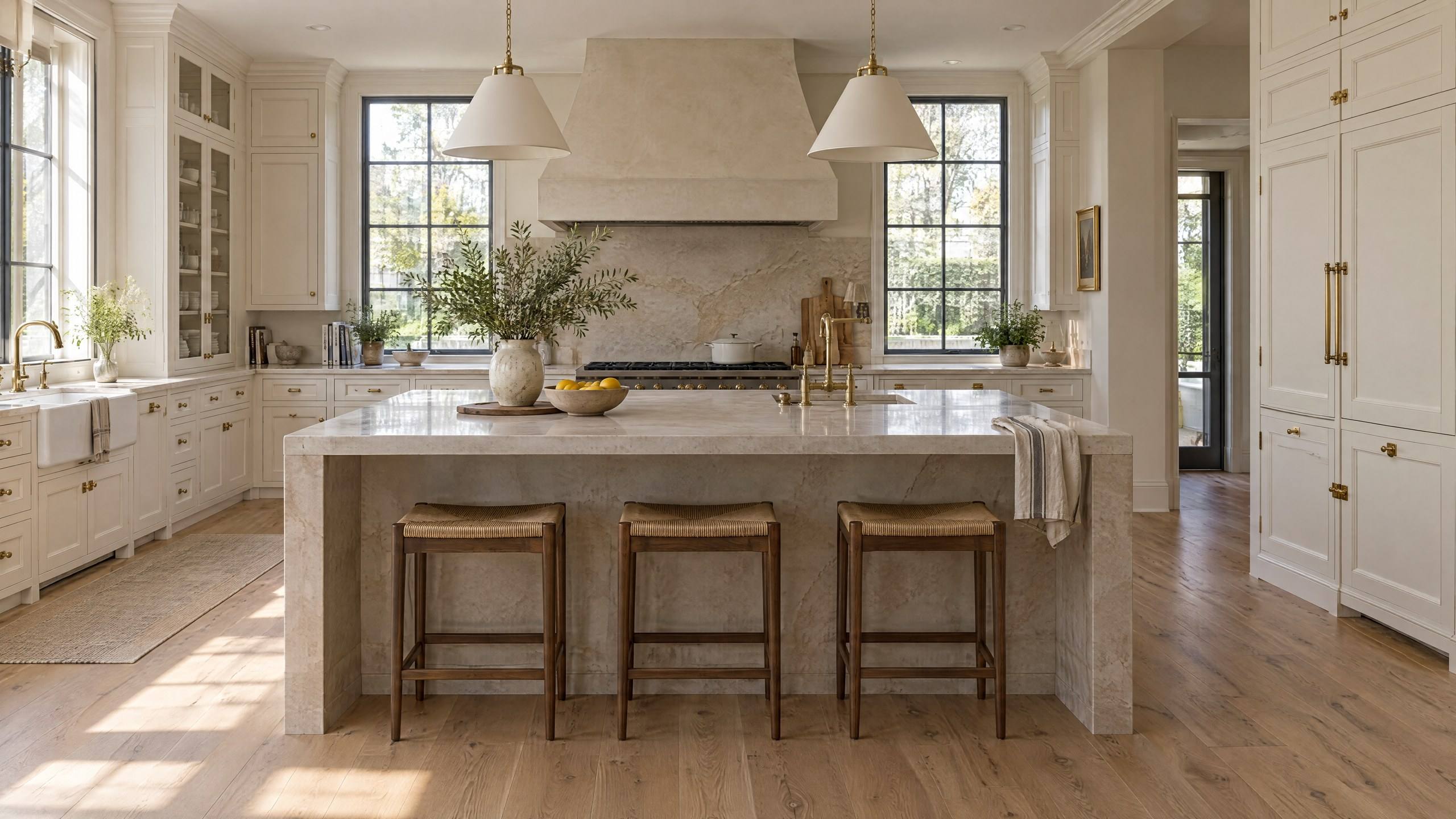
Inset doors sit inside the cabinet's face frame, flush with its front edge. Full overlay doors sit on the front of the box and cover nearly all of it. That one difference decides how the kitchen looks, which hinges you can use, how much the doors show seasonal wood movement and how much usable space you get inside each cabinet. If you're starting design meetings this fall for a spring project, settle door style early, because it shapes box construction, hardware and the fitting work that follows.
Side-by-side comparison
| Factor | Inset | Full overlay |
|---|---|---|
| Look | Door flush inside a visible frame; furniture-like, traditional | Doors cover the box; clean, continuous face |
| Reveals | Gap visible on all four sides of every door | Only narrow gaps between neighboring doors |
| Cabinet box | Requires a face frame | Frameless or framed |
| Hinges | Exposed butt or barrel hinges, or concealed inset hinges | Concealed cup hinges with easy adjustment |
| Seasonal movement | Shows in the reveals; can rub or open up | Mostly hidden |
| Interior space | Least, due to frame plus door inside the box | Most with frameless construction |
| Cost and fitting | Usually higher; each door fitted to its opening | Usually lower; less hand fitting |
Reveals: the gaps you'll look at every day
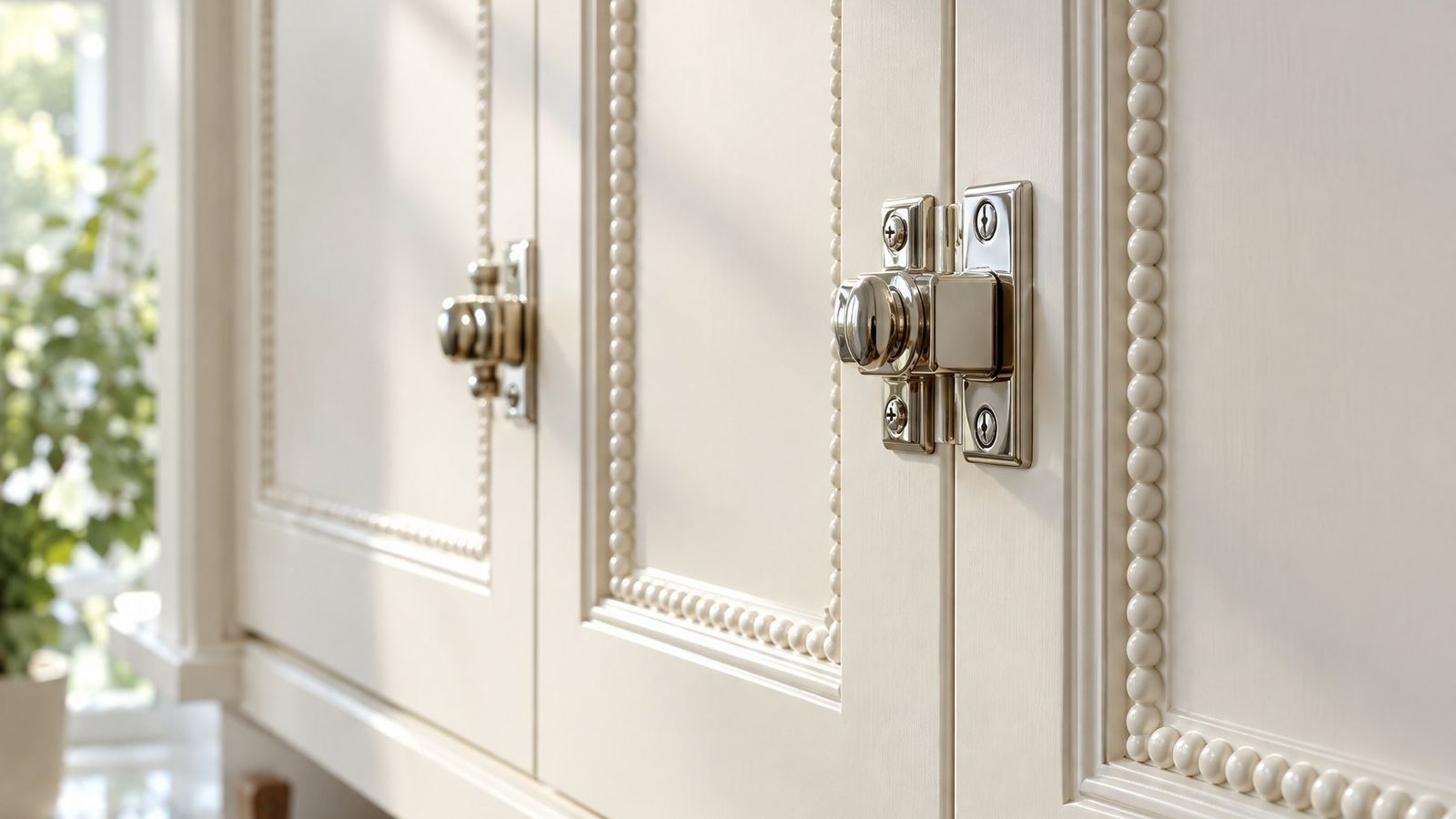
On an inset cabinet, the reveal is the gap between the door edge and the frame, and you see it on all four sides. Good inset work keeps that gap tight and consistent, commonly around an eighth of an inch. Your eye catches it quickly when one side is wider than the other, so the margin for error is small. The frame itself becomes part of the design, a grid of wood around every door and drawer. Beaded inset adds a small profiled bead around each opening for a more traditional look.
With full overlay, you see only the narrow lines between doors and drawer fronts. On framed full overlay the frame is mostly hidden; on frameless cabinets there's no frame at all. The whole run reads as one surface. If a door drifts out of line, it shows as a crooked gap between two doors, and a few turns of a hinge screw usually fix it.
Hinges and adjustment
Full overlay doors almost always use concealed cup hinges bored into the back of the door. They adjust in three directions with a screwdriver, and soft-close versions are widely available. Installers can dial in a whole kitchen of doors fairly quickly.
Inset gives you two routes:
- Exposed butt or barrel hinges suit a traditional kitchen and look right on period-style doors. They offer little adjustment, so correcting a sagging or rubbing door can mean resetting the hinge or planing the door edge.
- Concealed inset hinges bring screwdriver adjustment to inset doors, but the hinge and mounting plate take up room inside the box, and a door that's slightly off doesn't just look uneven, it rubs the frame.
Inset doors also need a stop or catch so they close flush instead of swinging past the frame. And since there's no door edge overhanging the box to grab, every inset door and drawer needs a knob or pull. Factor that into your hardware count. Hinge types get a fuller treatment in a separate article on this blog.
Seasonal movement
Wood takes on and gives up moisture as indoor humidity changes, and solid wood shifts slightly in size across the grain. Front Range homes get very dry during heating season, then pick up moisture again in warmer months. The broader effects of dry air on joints and paint are covered in another article; what matters here is how door style shows that movement.
An inset reveal puts movement on display. A door fitted during a humid stretch can open up gaps in winter. A door fitted in dry weather can tighten and rub when humidity rises. Full overlay hides most of this because the door edge isn't framed by a tight opening.
You can reduce the effect on inset cabinets:
- Choose five-piece doors with floating center panels, which let the panel move without pushing the frame apart.
- For painted inset, consider MDF center panels, which are more stable than solid wood.
- Let cabinets acclimate in the house before final door fitting.
- Account for paint thickness on door edges when setting reveals, since finish adds material to every edge.
Know what you're buying
Inset cabinets ask for occasional adjustment as the seasons change. That's normal behavior for the style, not a defect. If you'd be bothered by a reveal that shifts slightly between January and July, lean toward full overlay.
Storage space lost to the frame
Any face-frame cabinet gives up some width and height to the frame's stiles and rails. Drawers have to pass through the frame opening, so drawer boxes end up narrower than the cabinet itself. Roll-out shelves have to clear the frame and the hinge side of the door.
Inset loses a bit more. The door sits inside the frame, so it occupies depth that would otherwise be shelf space, and concealed inset hinges and door stops take more room inside the box.
Frameless full overlay gives the most usable interior: no frame, no center stile between a pair of doors and drawer boxes that run nearly the full width of the cabinet. The difference matters most in three places:
- Small kitchens where every cabinet has to work hard
- Narrow cabinets, which lose a larger share of their width to a frame
- Drawer bases for pots and pans, where drawer width is the whole point
Framed full overlay lands in between: you lose some space to the frame but not to a door sitting inside it.
Panel-ready appliances are another consideration. Integrated dishwasher and refrigerator panels generally blend more easily with full overlay. Inset kitchens can use them, but check the appliance manufacturer's spec sheet for door and panel requirements before cabinets are ordered.
Who each style suits
Choose full overlay if
- You want the most storage from each cabinet
- Your kitchen leans modern or transitional
- The kitchen gets heavy daily use and you want low upkeep
- You plan to panel appliances to match the cabinets
- Budget is a priority
Choose inset if
- The house has traditional or period architecture
- You want the cabinets to read like fine furniture
- You're comfortable paying more for precise fitting
- You accept seasonal reveal changes and occasional hinge tweaks
- The kitchen is large enough that some lost interior space won't hurt
Our call
For most family kitchens, and nearly every small one, we'd pick frameless full overlay. It holds more, adjusts easily and hides the seasonal movement that dry Colorado winters bring out. For an older home, or a kitchen where the cabinetry is meant to be the main design feature, inset earns its cost. Pair it with stable door construction and a finish plan that accounts for edge thickness.
Mixing styles can work if you keep inset to a piece that stands on its own, such as a freestanding-look hutch, rather than switching styles partway down a run. To see how we approach design and construction, start with our kitchen cabinetry services, or read through how our design and build process works before your first meeting.