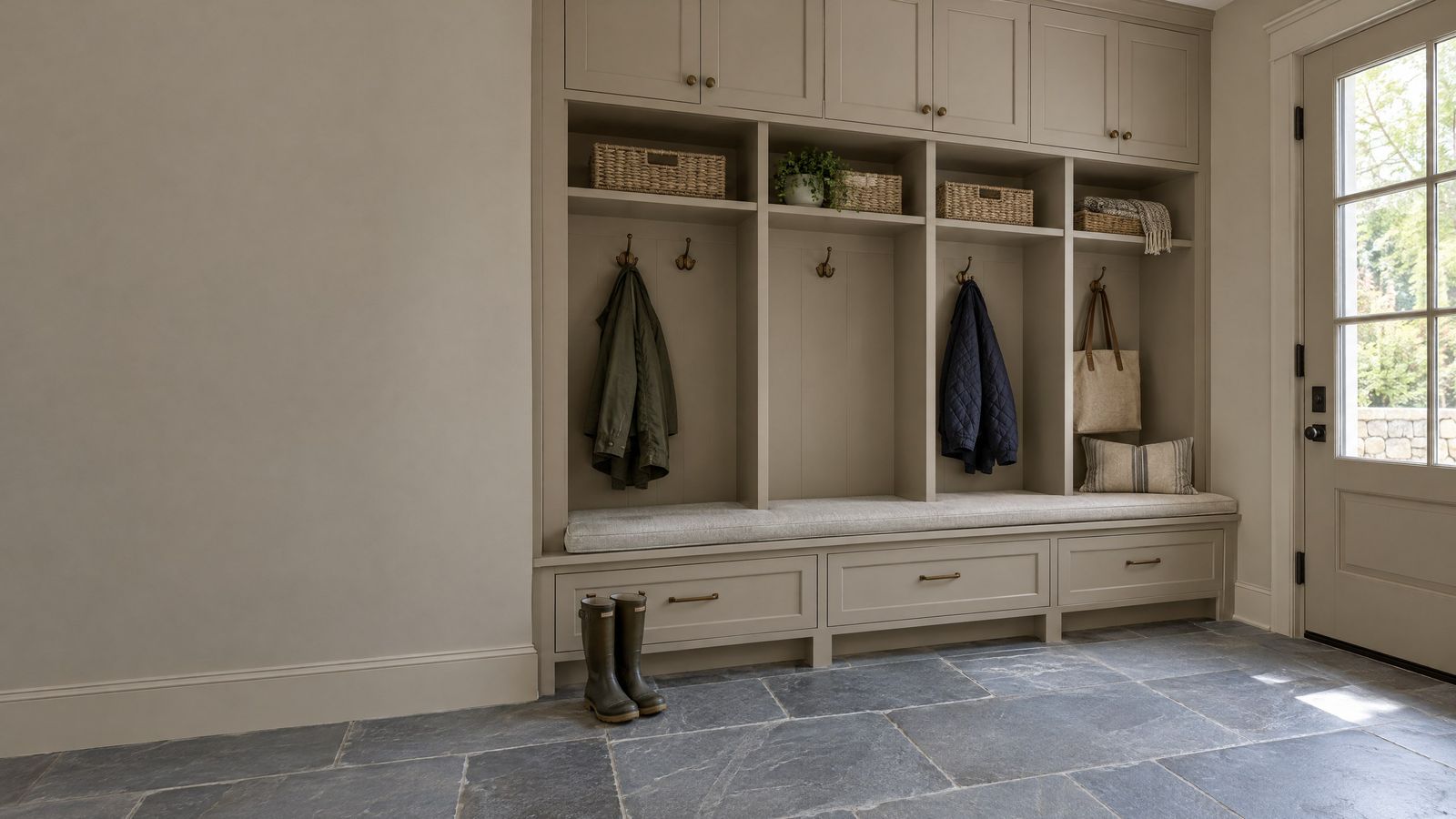
The parts of a mudroom cabinet that fail first are the ones that sit closest to the water: the toe kick, the bench top, the cubby floors and any doors that close over damp gear. Choose materials and finishes for those four places carefully and the rest of the cabinet can be built like any other quality built-in. From the first storm until spring, Front Range mudrooms see snowmelt every day. That's long enough for a poor material choice to show swelling, peeling or black stains by the time the snow stops.
Materials and finishes for the parts that get wet
Water damages cabinet materials mostly through exposed edges and end grain, not through a well-finished face. A painted MDF panel can look fine for months, then swell along one bottom edge where meltwater sat against it. So the question for each part is less "what is it made of" and more "what happens at the edges when water pools there."
| Part | What it faces | Our pick | Avoid |
|---|---|---|---|
| Toe kick | Puddles, wet mops, salt and grit from the floor | Cellular PVC kick, or plywood sealed on all faces and edges; or a raised base on legs | Raw or unsealed MDF and particleboard kicks |
| Bench top | Wet seats, dripping coats, dropped boots | White oak or another dense hardwood with a durable clear finish; high-pressure laminate on plywood for heavy family use | Painted MDF, softwoods that dent easily |
| Cubby floors | Standing water and snow from boots | Plywood with a laminate or melamine face, with sealed edges, under a removable tray | Melamine-faced particleboard with exposed or poorly banded front edges |
| Doors and panels | Damp coats pressed against them, splash at the bottom edge | Solid wood frames or plywood panels in a catalyzed finish; slatted or louvered fronts over wet storage | Solid doors closing over wet gear with no airflow |
Toe kick
This is the most abused part of the room and the easiest to protect. A cellular PVC toe kick doesn't absorb water at all and can be painted to match. If the cabinet is painted, plywood with every face and edge sealed before installation is a reasonable choice too. Another option we like for mudrooms is lifting the bench or lockers on legs so there's no kick at all. Water can't sit against something that isn't there, and you can mop underneath.
Bench top
White oak is a strong choice here. Its pores are naturally plugged in a way red oak's aren't, which makes it more resistant to water working into the grain. Pair it with a hard, durable clear finish such as conversion varnish and seal the underside and ends, not just the top. If kids will be dropping hockey bags on it, high-pressure laminate over plywood takes impact and water better than any wood, though it looks more utilitarian.
Cubby floors
Treat cubby floors as surfaces that will get wet no matter what. A plywood core holds up better than particleboard if water gets past the surface, and a laminate or melamine face sheds water well. The front edge matters most, since boots get kicked against it. Use a solid wood or thick edge band, sealed. Then put a tray on top so the floor rarely sees standing water at all.
Doors
Paint over MDF is common on mudroom doors and it's fine above the splash zone. Low doors, especially ones near the boot area, do better with a catalyzed finish and a sealed bottom edge, since that's where chips let water in. Over wet storage, we'd skip solid doors entirely. More on that below.
Seal every edge
Most mudroom water damage starts at an unfinished bottom edge, a cut end of a bench top or a drilled hole for a hook. Ask that cut edges and hardware holes be sealed before assembly, not just the faces you can see.
Ventilation
Wet gear in a closed cabinet stays wet. Colorado's dry winter air dries things fast once they're exposed to it, so the design goal is simple: let air reach the coats, gloves and boots. Dry air's other effects on wood cabinets are a separate topic covered elsewhere on our blog.
- Use open lockers or open cubbies for daily coats and boots. Save doors for dry, seasonal storage up high.
- If you want doors over wet storage for a cleaner look, choose slatted, louvered or perforated panels.
- Leave a gap behind hooks or use stand-off hooks so coats don't press flat against the back panel.
- Slatted shelves for gloves and hats dry faster than solid ones.
- Don't put a full-height cabinet tight against an exterior door where cold air and snow blow straight in.
Plug-in boot and glove dryers are popular in mudrooms. If you want one built into a cubby, plan the outlet location early. That wiring is work for a licensed electrician, and the cabinet layout should leave room for the cord and airflow around the unit.
Drainage trays
A boot tray is the cheapest protection in the room and it does more than any finish. The cabinet should be designed around the trays, not the other way around.
- Pick trays with a raised rim on all sides so meltwater stays in.
- Size cubbies to fit a standard tray you can buy again later, or have trays made to fit.
- Let trays sit on the cubby floor or slide out on their own, so you can carry them to a sink and rinse grit and salt off.
- Keep a small gap between the tray rim and the cabinet sides so water doesn't wick up the panels.
- For an open boot area under a bench, use one long tray instead of several small ones with seams between them.
Rubber and heavy plastic trays are easy to clean. Metal trays look sharper but can scratch the cubby floor, so add felt or rubber pads underneath. A tray filled with smooth river stones lets boots drain while the soles sit above the water.
Layout
Zone it from wet to dry
Put wet things low and dry things high. Boots and trays go on the floor level, the bench sits above them, coats hang above the bench, and upper cabinets with doors hold out-of-season gear, sports equipment and spare hats. This keeps drips falling onto surfaces built for them.
Give each person a column
Individual lockers or cubby columns cut down on piles. Each one gets a boot spot, a hook or two, a small cubby or basket for gloves and a high shelf. Set at least one hook low for kids.
Bench height and depth
Plan the bench at about the same height as a dining chair seat, so it's comfortable for pulling boots on. Make it deep enough to sit on without feeling perched, but not so deep that boot trays underneath get hard to reach. If the room is narrow, a shallower bench with open space below is better than a deep one that blocks the walkway.
Mind the door and the floor
Keep the cabinet clear of the exterior door's swing and leave a landing spot where people can stand while the door closes. If the floor is tile or another water-tolerant surface, a cabinet on legs or a recessed PVC kick works well. Flooring isn't part of our work, but it's worth confirming what's going down before the cabinet base is chosen.
Mudroom lockers, benches and cubbies are part of our custom built-ins for mudrooms, window seats and other rooms, built to fit your space and the gear your household actually uses. If you're planning one for this winter or next, send your room size and a few photos through our quote request form and we'll talk through materials for the wet zones.